
The Vagus Nerve
The Vagus Nerve extends from the hypothalamus area of your brain, hitting the ear, then going down through the chest, diaphragm, and then down to the intestines, with branches wrapping around your heart and communicating with many, many other organs on the way.
This very important nerve impacts every system of the body in one way or another. To paraphrase what I heard a fellow footzone instructor, Brad Noall, say (more than once) when I took his class about 10 years into my own years as a footzone therapist, “The Vagus Nerve is, or could be, the answer to nearly every question on a footzone class final test.” It is my belief, based on years of experience, that the Vagus Nerve impacts and plays a role, somehow or another, as this quote from Brad illustrates, with every system of the body!
I would like to share with you, in this newsletter, a small part of the things we discuss about the Vagus Nerve when holding Foot Zone classes at ButterflyExpressions. (I love to teach, especially anatomy for any reason whatsoever, so teaching ‘the Zone’ is particularly fun for me!)
Before we begin today’s discussion of essential oils, herbs, and Blessed Waters (homeopathics), I would like to provide a little bit of extraneous, but I feel quite necessary, information. I searched both the Butterfly Express and Butterfly Expressions sites and was disappointed to find that the information I have written and taught in various places over the years on the topic I am about to summarize briefly below is not to be found on either site. It doesn’t seem to be in any of the books I have written, either. (However, I made only a rudimentary search, so . . .) If this oversight is actually real, I intend to remedy the situation as soon as I can find a minute (or a few hours, as it will likely be).
Two key factors in understanding essential oils are recognizing the differences in healing properties among plant families and understanding how various parts of the same plant can offer different therapeutic benefits. It probably doesn’t surprise you that the medicinal properties of the conifer family (spruce trees, for example) are very different from the healing properties of the various herbaceous or ornamental plants (such as the Lauraceae, Labiate, Compositae, and Umbelliferae families).
Even within the same plant family, whether an essential oil has been created from the wood, the seed, the root, or the leaves, dramatically affects the healing properties of that essential oil, and does so to an incredible degree.
A well-built blend allows us to combine, synergistically, the benefits of several plant families as well as the healing capacities of various plant parts, all with the goal of increasing the capabilities of each single essential oil. Just as a chocolate cake is more pleasing—and tastes better—than the varying ingredients separately, an essential oil blend has the potential of being so much more than any of the single oil ingredients by themselves
Let’s keep this information in mind as we discuss various essential oil blends in the pages of this (and every) newsletter.
BHM
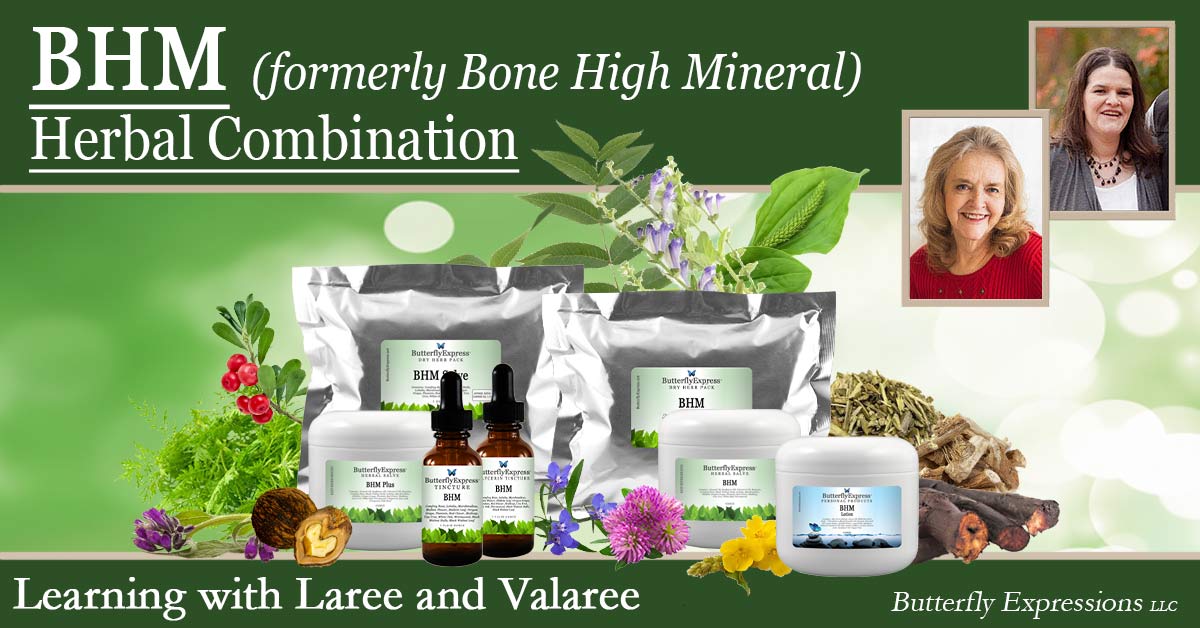
This herbal combination is comprised of some pretty amazing herbs.
Comfrey Root
Lobelia
Black Walnut Hulls
Mullein
Plantain
Marshmallow
Oregon Grape
Red Clover
Skullcap
Uva Ursi
White Oak
Wormwood
BHM is the best all-around super-nutritious herbal combination. My family has been using this remedy or variations, for nearly all the years of my married life—and that is a lot of years! What do the initials ‘BHM‘ stand for? BHM was formerly known as Bone-High Mineral.